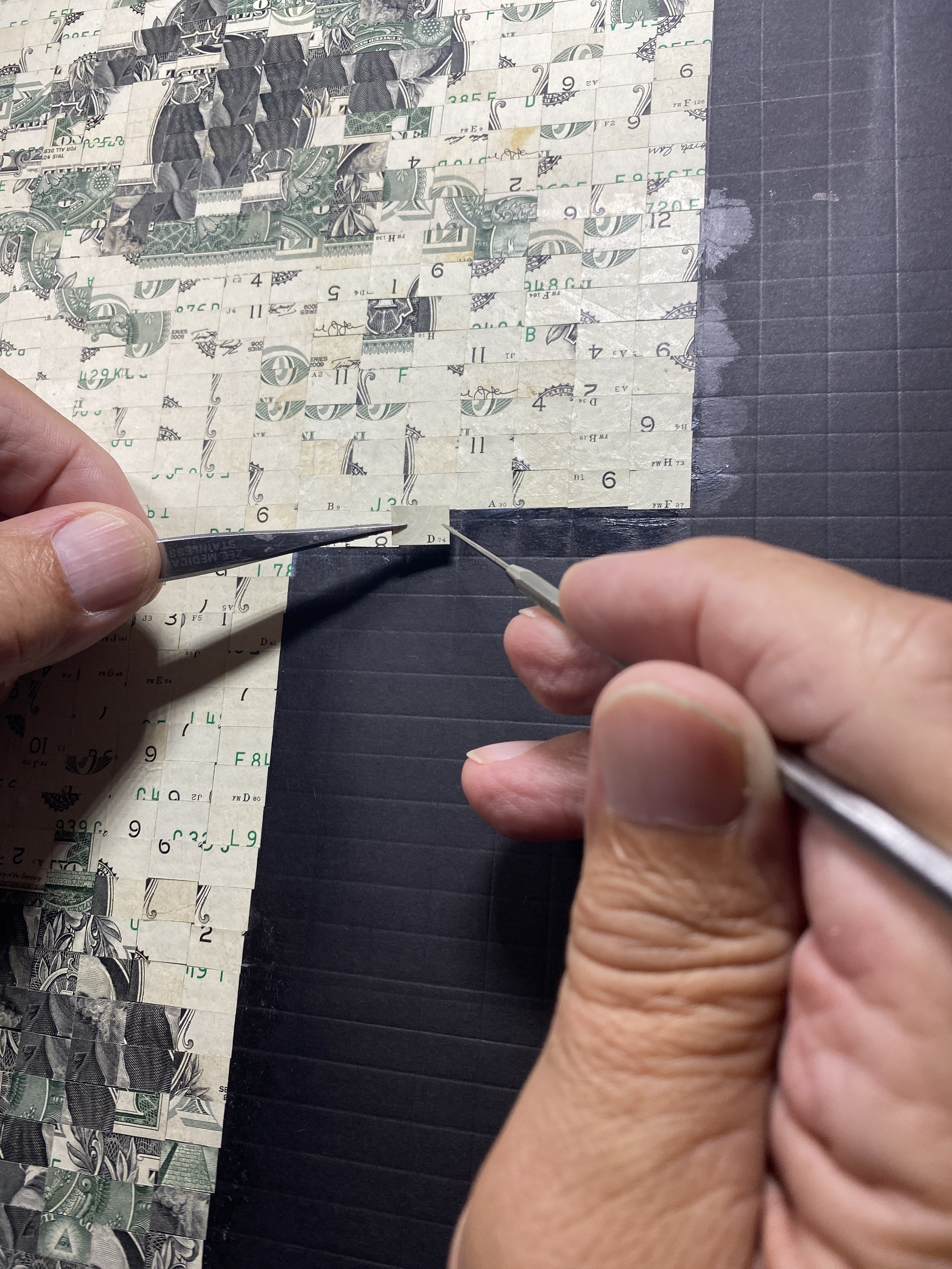
Creating currency collages is very time-consuming and requires concentration and patience. Generally, my artwork takes approximately 200 to 600 hours and approximately 2000 to 5000 pieces to complete.
It is generally legal to use money for art, provided the artist does not have fraudulent intent to alter its denomination or create counterfeits. While Section 333 of Title 18 of the U.S. Code prohibits mutilating currency to make it unfit for reissue, this is typically only prosecuted if the intent is to defraud or destroy the currency.
Dive into my process and methodology.
Dollar Bill Preparation.
I use one-dollar bills to create my collages. I carefully cut each bill into 84 equal pieces. Because I use both sides of the bill, I have 168 pieces to choose from. I start with my least-favorite part of the process—cutting a stack of $1 bills into 84 pieces each. Then I mount the cut pieces onto the adhesive pages of a photo album.
I also keep a fully cut $1 bill mounted between two plates of glass when choosing a piece, so I can quickly compare the front and back and find the best color or tone for each area of the image.
Mapping Out the Portrait.
After I choose my subject and photo, I study the image closely and draw horizontal and vertical lines over it to create a grid. This is also when I decide the dimensions of the final artwork—generally, the more pieces I use, the more realistic the portrait becomes.
I always begin a new portrait with the eyes. Capturing the eyes is essential because they hold the expression and essence of the person. Once the eyes look right, I glue them down and build the rest of the face around them. This is the most time-consuming part of the process.
Executing the Grid.
Then I scale up from my model grid and draw the full-size grid for the final artwork on my foam board. Using my gridded reference photo, I match each square to the closest color or tone from my 168 available pieces and glue them onto the board one at a time. As the eyes, nose, and face start to come together, the portrait becomes easier to build—but it still takes a long time to finish.